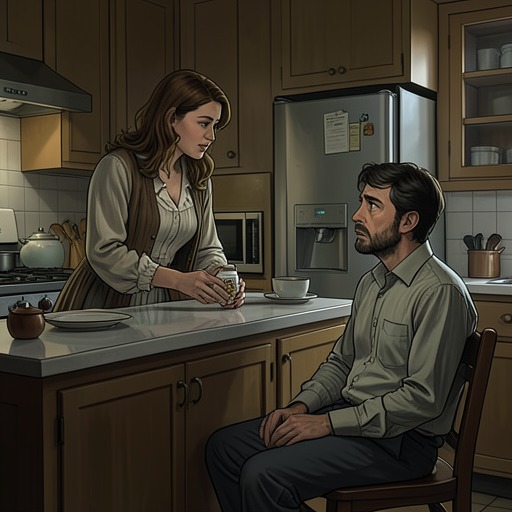
Stephen
The Thursday Murder ClubStephen’s decline changes the shape of Elizabeth’s life: the husband who once travelled, researched, and wrote for hours increasingly depends on her care, yet remains present in the habits and friendships they share. His story is not only one of memory failing, but of a marriage adjusting to that loss without reducing him to it.
Identity and Background
Stephen is an expert in Middle-Eastern Art, perhaps the leading British academic in his field. He lived in Tehran and Beirut during the 1960s and 1970s. Years later, he travelled to identify looted masterpieces on behalf of once-wealthy exiles in west London. His career is defined by sustained attention to art and its histories, a pursuit that eventually becomes harder to continue as his health worsens.
Elizabeth had briefly been in Beirut in the early 1970s, but the two did not meet there. Their lives converged in 2004 outside a bookshop in Chipping Norton, where Stephen picked up a glove Elizabeth had dropped. They married six months later. The small, accidental kindness of their meeting stands in contrast to the long, demanding work of their marriage: they began with a glove retrieved in the street and came to face illness that could not be retrieved from the past.
Memory and Decline
The change in Stephen’s memory becomes unmistakable when he speaks as if Emily were his daughter and asks that she visit more often so they can keep an eye on her. Emily was not his daughter: she was his first wife, who had died nearly twenty-five years earlier. The mistake is especially painful because Stephen’s concern sounds like ordinary, loving solicitude, while its underlying confusion reveals how far the past has displaced the present.
His writing retains traces of that past. He still writes every day, sometimes for hours, and keeps his work locked away. Elizabeth reads it from time to time: sometimes it consists of a newspaper passage copied repeatedly; more often it is stories about Emily or written for her, in beautiful handwriting. The pages preserve his capacity for expression while also showing how his attention returns to someone long dead. His former academic life is narrowing, but the writing continues, holding a connection that Elizabeth cannot simply correct or erase.
By the time Elizabeth confronts the extent of his illness, she knows there will be no more journeys to London to meet his agent, see exhibitions, or consult the British Library. She recognizes that Stephen is already beyond the point at which such outings are possible. She manages the situation with medication, including sedation; with the pills she gives him and the ones he takes himself, he no longer wakes in the night. Her care keeps the household going, but the quiet it achieves comes at the cost of his independence and of Elizabeth having to make decisions on his behalf.
Care, Habit, and Companionship
Stephen’s needs are described through the practical limits that organize Elizabeth’s days. He does not cook, go to the shop, visit a restaurant, or go to the pool, so she believes he will not cause an incident while she is out. She sometimes returns to a poorly concealed flood or emergency washing. These domestic disruptions do not become grand crises; they are the repeated, intimate work of living with someone whose abilities and routines have changed.
Elizabeth’s vigilance also makes ordinary details carry unusual weight. When she comes home and sees that the curtains in Stephen’s study are open, she knows at once that something is wrong: he always keeps them closed to avoid the morning sun’s glare while he writes. Her thoughts move rapidly from a broken routine to the possibility that he is hurt or dead. The scene shows how closely she has learned his habits, and how the very familiarity that allows her to care for him also makes any departure from routine frightening.
At another point, Elizabeth wakes in darkness beside Stephen and wonders whether he can feel her arm around him. She fears that he and Penny may already have disappeared from her life, and clings more tightly to the day she has just lived. When a late-night call comes from Donna De Freitas, Elizabeth switches on the bedside light and sees Stephen’s chest rising and falling. His breathing is a simple sign of life, but the moment’s force comes from how carefully she watches for it.
Friendship and the Chessboard
Stephen’s connection with Bogdan gives him a social life that is not defined solely by Elizabeth’s caregiving. One day, Elizabeth returns to find the two men playing chess in the living room. She had noticed the open study curtains and feared that something had happened; instead, Stephen and Bogdan are smiling across the board. Bogdan’s surprise at seeing Elizabeth, and her own relief at finding them together, turns an apparent disturbance into a scene of welcome.
The friendship recurs in the chess games. Bogdan studies the board, taps the table, and tries to avoid losing to Stephen, whom he regards as a formidable opponent. Stephen asks whether he can put a question to Bogdan while Bogdan is concentrating, and Bogdan answers that he can always ask because they are friends. The exchange gives Stephen room to act as a participant and companion, not merely as the person being watched over. Chess supplies a shared activity with its own demands: attention, patience, and the possibility of surprise.
Elizabeth leaves Stephen sleeping, expecting Bogdan to come by after work for another game and hoping that both men will still be there when she returns. She needs their company. The hope is modest but consequential: as Stephen’s world contracts, the friendship between him and Bogdan creates a point of connection that belongs to both men.
Change and Narrative Significance
Stephen’s illness makes Elizabeth’s fear of death immediate. While waiting alone in the cold chapel for a man who might be coming to confess—or might be carrying fentanyl—she thinks of Stephen. The thought interrupts the danger of the present with the vulnerability waiting at home: whatever else Elizabeth has to face, she cannot treat the possibility of losing her husband as an abstraction.
In the closing scene, Elizabeth thinks about Penny, who is surely dead, and John, who has taken care of her at great cost. She also thinks of Annie Madeley and the life Annie missed. The thought that everyone eventually has to leave the game brings the chess motif into contact with mortality. Elizabeth reaches for Stephen’s temazepam, then pauses and puts it back in the cupboard. Returning to him, she takes his hand and kisses him. When she suggests that it may be time to cut down on coffee, Stephen accepts her judgment. The gesture marks a change in Elizabeth’s care: she does not reach for the medication that could quiet him, but chooses a small, ordinary act of continued companionship instead.
Stephen’s narrative role rests on this tension between what has been lost and what remains. His mistaken memory of Emily, repetitive writing, and increasing dependence reveal the severity of his decline; his expertise, beautiful handwriting, chess, and friendship with Bogdan keep him from being defined by that decline alone. Elizabeth’s final pause does not undo the illness. It shows, instead, that care can still contain a choice—and that she chooses, for that moment, to stay beside the person who is still there.